QuixiCloud vs. Google Drive: The Privacy-First Choice for Your Business Data
When you upload a confidential business contract, a client’s architectural blueprint, or a proprietary database to the cloud, who else can see it?
For most businesses relying on mainstream platforms like Google Drive, the answer is more complicated than you might think. While Google provides incredible convenience and collaborative tools, it operates on an infrastructure model where it ultimately holds the keys to your data.
If data sovereignty, client confidentiality, and absolute privacy are non-negotiable for your business, you need a different kind of architecture. Here is why switching to a privacy-first provider like QuixiCloud is the smartest move you can make for your company’s security.
The Google Drive Reality: Convenient, But They Hold the Keys
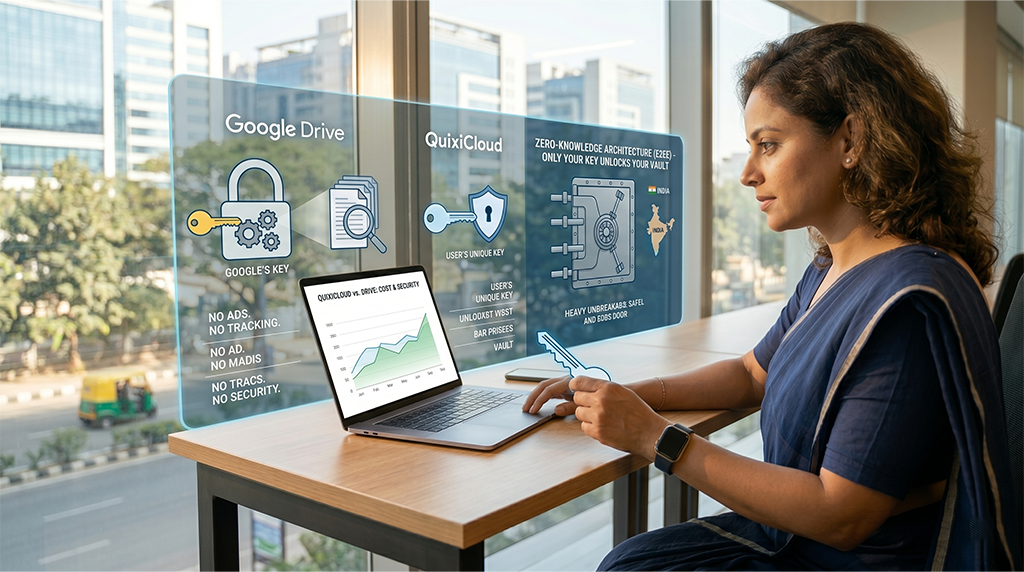
Google Drive is undeniably powerful, but its core architecture is built around Google having access to your files.
-
Data Scanning & Processing: To provide features like advanced search within documents, spam filtering, and virus detection, Google processes and scans the content you upload.
-
Server-Side Encryption Keys: While Google encrypts your data both in transit and at rest in their data centers, Google retains the master decryption keys. This means that under legal pressure, or in the unlikely event of an internal breach, your raw data could theoretically be accessed, decrypted, and handed over to third parties or authorities.
-
Third-Party Processing: Google’s privacy policy allows for personal information to be provided to affiliates and trusted businesses for external processing, based on their instructions.
The QuixiCloud Difference: Zero-Knowledge Architecture
QuixiCloud was built from the ground up to treat your data as entirely your own, utilizing a rigorous security model known as Zero-Knowledge Encryption.
-
End-to-End Encryption (E2EE): Before a file ever leaves your laptop or mobile device, it is encrypted locally.
-
You Hold the Key: Unlike Google, QuixiCloud does not store your decryption keys on their cloud servers. Even if QuixiCloud’s servers were compromised, attackers would only find mathematically unreadable ciphertext. QuixiCloud literally cannot see, scan, or sell your data.
-
Hardware-Level Security: For mobile users backing up their data via the QuixiCloud Sync app, Vault passwords are locked directly within the device’s native Android Keystore (AES-256), ensuring top-tier isolation from malicious apps.
No Ads, No Tracking, No Hidden Agendas
The core philosophy of a privacy-first cloud dictates how it treats its users and their digital footprint.
-
The Big Tech Ecosystem: Free or subsidized cloud storage is often paid for by locking you into a larger, data-driven ecosystem. While Google explicitly states they do not use your Drive content for personalized advertising, your interaction with their broader ecosystem is heavily monitored to build your profile.
-
The QuixiCloud Model: QuixiCloud operates on a strict “no tracking” mandate. Your personal data and app usage are never monetized, and there are absolutely no targeted ads. You are treated as a valued, paying customer—not a product to be mined.
Pricing: Enterprise Privacy Doesn’t Have to Cost More
Historically, highly specialized, zero-knowledge cloud storage came with a massive premium. However, QuixiCloud manages to undercut traditional consumer providers while offering superior, enterprise-grade security.
-
Cost Efficiency: A standard 2TB business plan on Google Drive or Dropbox is noticeably more expensive than QuixiCloud’s equivalent 2TB tier. By switching, you significantly reduce your total software overhead while upgrading your privacy.
-
Unlimited Potential: For design agencies and businesses that scale rapidly, QuixiCloud offers unlimited storage options without hidden file-size limits, perfectly accommodating massive 4K video files or 3D renders.
The Verdict
If your team’s primary goal is real-time, simultaneous document editing in a web browser, the Google Workspace ecosystem remains a strong, convenient contender.
However, if your priority is absolute data security, maintaining strict client NDAs, and ensuring that no third party—not even your storage provider—can look at your files, QuixiCloud is the definitive choice.
Recent Posts
Other Blog Post:
When you upload a confidential business contract, a client's architectural blueprint, or a proprietary database
-

Secure Cloud Storage – Experience True Data Security
January 27, 2025 -

Send Large Files Fast
January 27, 2025